


Blockchain trilemma: is it possible to have everything at once?
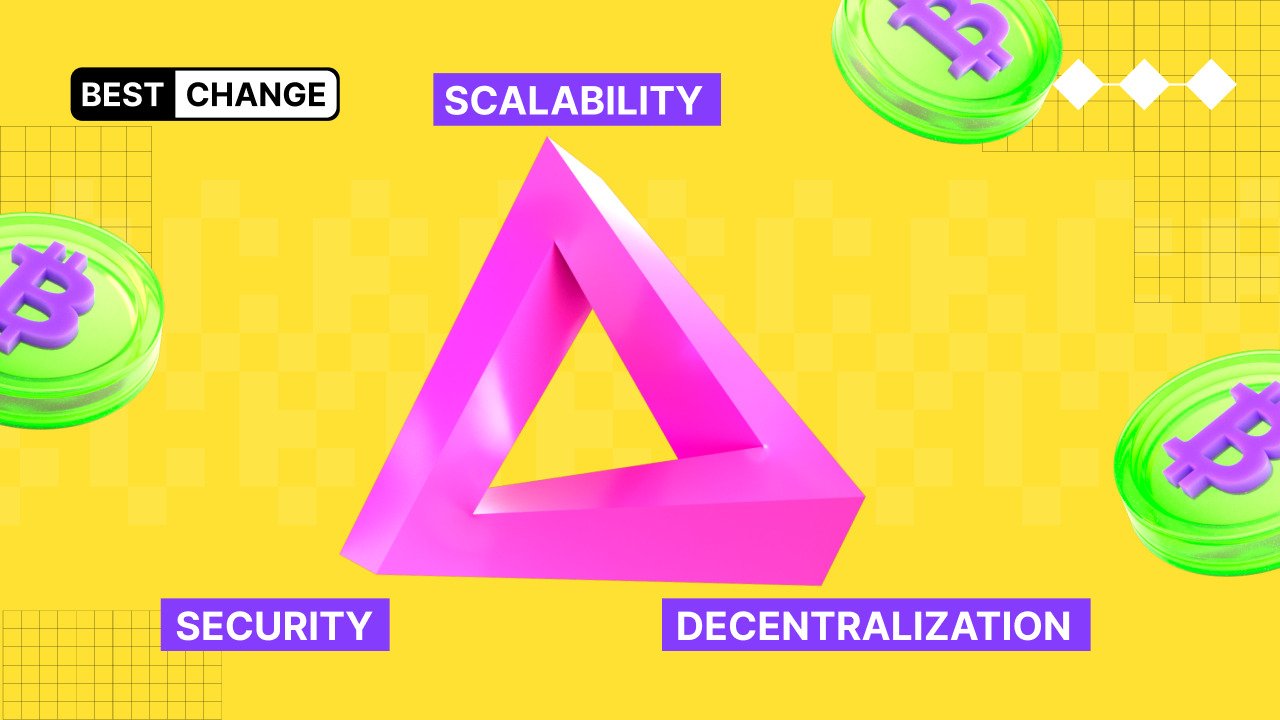
At its core, a blockchain is a database that stores transaction information. However, unlike traditional databases, a blockchain operates autonomously and has three key properties:
- scalability,
- security,
- decentralization.
These three properties are exactly what the well-known blockchain trilemma* addresses.
* A trilemma is a situation in which, out of three interconnected properties or goals, it is impossible to achieve all three at the same time fully; achieving two of them inevitably limits the third.
What is the blockchain trilemma?
The blockchain trilemma describes the challenge of creating networks that are simultaneously scalable, secure, and decentralized. According to the blockchain trilemma, at least one of the three qualities must be sacrificed. Moreover, the better one property is implemented, the worse another tends to be.
For example, high-performance, secure networks such as Ethereum and Solana are considered less decentralized than other networks. Meanwhile, decentralized and secure networks such as Bitcoin and Litecoin are less scalable, in accordance with the blockchain trilemma.
The blockchain trilemma is based on the CAP theorem, also known as Brewer's theorem, which appeared in the 1990s. According to Brewer's theorem, in any distributed computing system, it is possible to achieve only two of the following three key properties: consistency, availability, and partition tolerance. Later, an adapted version of CAP theory was developed for the Web3 sphere, known as the blockchain trilemma.
The term "blockchain trilemma" was popularized by Ethereum co-founder Vitalik Buterin. It was Buterin who proposed one of the first solutions to the blockchain trilemma by introducing a high-performance blockchain network based on smart contracts that can autonomously process transactions without third-party involvement. His platform, Ethereum, became the foundation for creating decentralized applications (dApps). Later, it even became the launchpad for the development of an entire decentralized finance (DeFi) sector.
Key aspects of the blockchain trilemmaSecurity
The first of the three main properties of the blockchain trilemma is the security of decentralized networks, ensured by encryption algorithms such as SHA256 in Bitcoin and Scrypt in Litecoin, as well as by consensus mechanisms. Within the framework of the blockchain trilemma, security determines how resistant a network is to external and internal threats, such as a 51% attack.
Decentralization
Decentralization is the second property of the blockchain trilemma and implies that there is no central authority controlling the public network.
A high degree of decentralization makes a network more resistant to attacks; however, it reduces performance because nodes spend more time reaching consensus on each transaction.
Scalability
The third property of the blockchain trilemma is scalability, which determines the throughput of decentralized networks. Scalability shows how many transactions per second (TPS) a network can process.
The Bitcoin network demonstrates how high security levels affect performance: the Bitcoin blockchain can process only 7 transactions per second. The performance of newer blockchains reaches several thousand TPS:
- Solana — up to 65,000;
- Avalanche — up to 4,500;
- TRON — up to 2,500 thousand TPS;
- Layer-2 networks (Arbitrum, Polygon, OP Mainnet, etc.) — up to several tens of thousands of TPS.
High performance makes transactions fast and inexpensive; however, in practice, this often comes at the cost of reduced decentralization.
What solutions to the blockchain trilemma exist today?
Layer-2 solutions and sidechains
One solution to the blockchain trilemma is Layer-2 (L2) networks. Layer-2 solutions process transactions outside the main network, thereby reducing its load and ensuring scalability.
Well-known Layer-2 solutions for scaling Ethereum include:
There are also Layer-2 solutions for scaling the Bitcoin blockchain, such as Stacks and the Lightning Network. Additionally, independent third-party blockchains, or sidechains, such as Rootstock and Liquid Network, are used to scale Bitcoin.
New consensus mechanisms
While some developers create external networks to address the blockchain trilemma, others aim to solve it at the protocol level itself.
The Solana network operates based on the Proof-of-History (PoH) mechanism, which enables high performance through rapid node synchronization while maintaining a high level of network security.
An alternative approach to solving the blockchain trilemma is the use of Zero Knowledge (ZK-Proof) technology, on which blockchains such as Zcash, Starknet, and Mina Protocol operate. Among other things, this approach enhances transaction privacy.
Other developers design hybrid networks that combine different functions to solve the blockchain trilemma. For example, the BNB Chain network uses the Proof-of-Staked Authority (PoSA) mechanism, enabling the creation of new blocks every 3 seconds.
Sharding
Another solution to the blockchain trilemma is sharding — splitting the blockchain into several parallel networks (shards), each responsible for processing its own segment of transactions. This approach increases blockchain performance without sacrificing decentralization.
The sharding mechanism is implemented in blockchains such as NEAR Protocol and TON. Since 2022, sharding has also been introduced into the Ethereum network, significantly increasing its performance: from 15 to more than 200 TPS.
Modular blockchains
Modular networks aim to address the blockchain trilemma by improving performance without compromising security or decentralization. The essence of a modular blockchain is that developers can upgrade individual protocol components without affecting the operation of the entire network. However, this approach creates new challenges in ensuring network security.
Examples of modular networks addressing the blockchain trilemma include Celestia and Validium. Such networks are flexible and allow tasks to be distributed across different blockchain layers.