


Rug pull in cryptocurrencies — how to identify a scam project
Cryptocurrencies, due to their anonymous nature, weak regulation, and lack of restrictions, attract the attention of criminals who seek to steal digital assets in various ways.
One such method is a rug pull. According to Chainalysis, in 2025 alone, the total damage caused by rug pull scams ranged from $14 to $17 billion.
What is a rug pull?
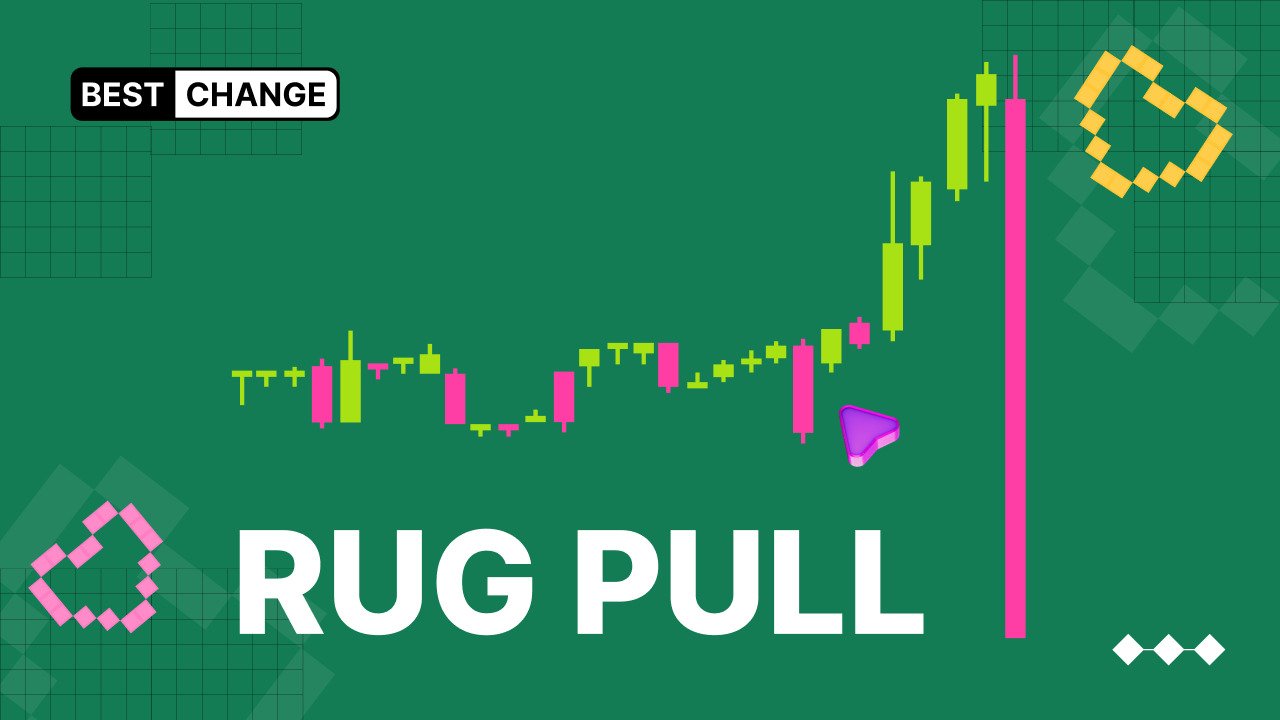
Rug pull literally means "pulling the rug out from under someone's feet." A Rug Pull is a fraudulent scheme in which scammers attract victims' funds into their projects and then suddenly disappear with investors' money — as if pulling the rug out from under their feet, which is how the scheme got its name.
Here is an example of how a typical rug pull works:
- Scammers launch a project and issue their own token.
- Then the criminal team actively promotes their token so that investors buy it;
- At some point, when the scammers consider the received profit sufficient, the project is quickly shut down, and the team deletes the website and social media pages, leaving investors with useless shitcoins* — that is, they perform a rug pull.
* Shitcoins are crypto assets that are not based on a sustainable economic model and do not solve a specific practical problem. As a rule, they lack clear sources of long-term demand: the token is not needed to pay fees, does not grant access to a sought-after service, and is not used as a governance tool within an ecosystem. The value of such coins is formed through short-term hype: advertising, social media buzz, "pump" campaigns, and expectations of rapid growth. Therefore, the price of shitcoins is highly dependent on market sentiment and can easily collapse.
Note: in some cases, rug pull scammers may withdraw funds gradually to avoid raising suspicion among victims and continue attracting money. Therefore, a distinction is also made between a "soft" and a "hard" rug pull. The latter involves a rapid disappearance.
Rug pulls are prevalent in the decentralized finance (DeFi) space and are often carried out using a variety of tokens, including NFTs and memecoins. The absence of KYC* in DeFi projects makes it difficult to track down scammers. The search for fraudsters is itself a costly service, with prices reaching $10,000 or more, making attempts to recover funds pointless if the damage from a rug pull is $15,000 or less.
* KYC (Know Your Customer) is a set of procedures and requirements aimed at establishing and verifying the identity of users, including the collection and verification of personal data. These measures are used to reduce the risks of fraud, money laundering, and financing of illegal activities, as well as to increase transparency and accountability among participants of financial and cryptocurrency platforms.
Examples of well-known rug pulls
- OneCoin (2017). The project operated as a Ponzi scheme, and its founder stole $4 billion from investors and disappeared. OneCoin remains one of the largest rug pulls in the history of cryptocurrencies, and its creator has yet to be found. OneCoin is considered the first rug pull in the crypto industry.
- BitConnect (2018). The project appeared promising to many investors, and its BCC token was listed on major exchanges and even ranked among the top ten cryptocurrencies on CoinMarketCap. However, BitConnect ultimately turned out to be a classic rug pull implemented through a Ponzi scheme, whose organizers disappeared with $1.1 billion of investors' funds.
- SHARPEI (2024). A memecoin created based on the image of a Shar Pei dog. The project gained support from well-known bloggers, but following a rug pull, its founders withdrew at least $3.4 million from liquidity pools.
- ZKasino (2024). A project positioning itself as a gaming platform within the zkSync ecosystem. However, after financial problems began, the ZKasino team carried out a rug pull, disappearing with investors' assets worth approximately $33 million.
- Aqua (2025). The project was initially positioned as an affordable trading infrastructure but ultimately turned out to be a rug pull, with the organizers stealing nearly 22,000 SOL tokens worth about $4.5 million.
How to identify a rug pull: signs of a potential crypto scam
Attentiveness and awareness are key to protecting yourself from fraudulent schemes such as rug pulls. The main danger of schemes like Rug Pull lies in the fact that it is not always easy to recognize a scam project. However, several simple techniques can help identify a rug pull and protect your assets.
Comprehensive project analysis
In the crypto community, the term Do Your Own Research (DYOR)* is widely used: experienced crypto users often urge others to always "do their own research." To protect yourself from a rug pull, you should carefully study all information related to a project before investing:
- Who is behind the project, and whether the team has successful cases. It is worth checking the project's LinkedIn and GitHub. Any project should be actively developing and receiving updates, as evidenced by GitHub activity.
- Whether the project has partners well known in the crypto community: large companies such as Binance or Coinbase value their reputation and will not associate with suspicious projects;
- What is contained in the whitepaper and roadmap? Empty documents or those containing only vague statements are a warning sign of a potential rug pull in the future.
- How the team communicates with the community and how engaged it is. Social activity can be checked using tools such as Twitter Score and Telemetr.
- What the project's core value, plans, and goals are;
- Whether a listing on major exchanges is planned;
- What the media and thematic blogs write about the project, and whether there are mentions on social media.
* DYOR (Do Your Own Research) is a principle of responsible investing, according to which users independently analyze a project, its team, technology, tokenomics, and risks, without relying solely on advertising, influencer advice, or public opinion.
If the information studied raises doubts and suspicions that are also discussed within the community, the user may be dealing with a rug pull, and it is better to avoid investing in such a project. Even influencers can promote rug-pull projects without realizing it. For example, Kim Kardashian promoted the EthereumMax token, which later turned out to be a rug pull.
It should be noted that listing on CoinMarketCap does not guarantee the absence of fraud. For example, the most high-profile rug pull of 2021 involving the SQUID token, inspired by the popular TV series Squid Game, had its own page on the CMC website, which earned the trust of many investors — a fatal mistake.
It is also worth considering that not every project whose team carried out a rug pull was initially intended as a scam. For example, founders may resort to a rug pull in the event of an anticipated project collapse. Therefore, it is essential to monitor project metrics using tools such as CoinMarketCap, Dune Analytics, and TokenTerminal.
If a user nevertheless decides to take the risk and invest in a questionable project, they should invest only the amount they are prepared to lose in advance.
Smart contract check
According to Solidus Labs statistics, 75% of fraudulent projects had unaudited smart contracts. Scam tokens can often be identified already at this stage, as their smart contracts may contain unusual functions — for example, the inability to sell the asset, as was the case with the previously mentioned SQUID token.
You can check a smart contract for suspicious functions and signs of a rug pull using specialized services such as Token Sniffer, Bscheck, and De.Fi Scanner, and CertiK. You can also check whether the project is listed on the RugDog website, which publishes projects suspected of being rug pulls.
It is also necessary to check the contract for liquidity lock*, which can be done using the Honeypot tool. Equally important is whether the contract has protection against MEV attacks*.
* Liquidity lock is an investor protection mechanism in which liquidity tokens (LP tokens), representing a share of funds in a pool, are placed into a smart contract with withdrawal restrictions for a specified period or permanently. This measure reduces the risk of a rug pull, as the project team is technically deprived of the ability to withdraw liquidity and crash the token price instantly.
* MEV attacks (Maximal Extractable Value) are a type of abuse in blockchain networks in which validators, miners, or specialized bots manipulate the order of transaction processing to extract additional profit. The absence of MEV protection can lead to artificially inflated fees and direct financial losses for users, making such projects less secure for investment.
On-chain analysis
When checking a smart contract, additional information may be found that raises suspicions of a rug pull. For example, using block explorers such as Etherscan or Solscan, you can check how many tokens are concentrated in the team's wallets. If this value exceeds 80%, scammers can sell a large number of tokens, triggering a price collapse for the asset.
More in-depth on-chain analysis can be performed using advanced tools such as Dune Analytics and Nansen, which allow tracking the activity of large holders. The Arkham platform supports AI-powered tools that make it easier and faster to detect a potential rug pull. Tools like DexScreener also let you evaluate a project's tokenomics, an important indicator for identifying a rug pull.
Unrealistic profit promises
Investing always involves risk, so only scammers can promise guaranteed profits. Many fraudulent teams resort to FOMO tactics, actively convincing victims that they will regret missing out on profits if they do not buy the token now. If a user notices this red flag when reviewing a project, they are most likely dealing with a rug pull.
Aggressive marketing
Another sign of a rug pull may be the team's excessive focus on token profitability and its promotion using such schemes. Rug pulls often involve ads claiming massive token price growth of 1000% or more. Experts advise avoiding projects with such aggressive marketing.